All posts by vfwpost2713

Veterans SEA MOAA picnic-ACTION 8/26 11am-2pm

SEA MOAA Veteran’s Picnic
Wed. August 26th at Seward Park, Picnic site #1
Picnic 11:00 – 14:00

Please plan on coming to enjoy the picnic with all of the Veterans from the Seattle VA Hospital and other SEA MOAA members.

SEA MOAA will provide the following: Chili, hotdogs, hamburgers, buns and condiments, water, ice, soda pop, pickles & olives, diced sweet onions, lettuce & tomato and a variety of chips.

RSVP to Jay Murray: Telephone 206-932-6064 or email murraysj2@msn.com by Monday August 24, 2015 so we can purchase enough food, beverages, etc.

Please pass on this information to others. The area is wheelchair accessible. We hope to have a big turnout. See You there.

Jay Murray
VA Picnic Coordinator

President Obama Nominates Mike Michaud for Assistant Secretary of DOL-VETS

Former U.S. Representative to be Assistant Secretary of Veterans Employment and Training Service

Washington – President Obama today announced that he is nominating former U.S. Representative Mike Michaud for the position of Assistant Secretary of the Veterans Employment and Training Service at the Department of Labor (DOL-VETS).

Mr. Michaud had been a member of the House of Representatives from 2003 until the 114th Congress.
As the Democratic Representative from Maine’s 2nd Congressional District, Mr. Michaud had a large impact on veteran issues through his seat on the House Veterans Affairs Committee. He served as the Ranking Member of that Committee, as well as the Health Subcommittee. In his work in these positions he was a committed advocate for homeless veterans and the programs that serve them, especially on areas that addressed employment and education.

DOL-VETS is responsible for a wide range of veteran specific programs at the Department of Labor, including the Homeless Veteran Reintegration Program (HVRP), Jobs for Veteran State Grants (JVSG), and Stand Downs. Last year they served 1.1 million veterans and helped them gain employment.

The position is currently held by Acting Assistant Secretary Teresa Gerton, who has held the position since the retirement of Assistant Secretary Keith Kelly earlier this year. Ms. Gerton had previously held the position of Deputy Assistant Secretary for Policy at DOL-VETS, and has been an impactful leader on the issue of veteran homelessness in both positions.

NCHV Executive Director Baylee Crone said of the nomination, “NCHV looks forward to the arrival of Mr. Michaud at DOL-VETS, and is excited to be re-gaining a partner with such a long history of committed advocacy on behalf of this country’s homeless veterans.”

Operation: WelcomeOneHome Event

Today is the Day!!!

The US Declared War on Veteran Homelessness and it Actually Could Win

http://www.npr.org/2015/08/04/427419718/the-u-s-declared-war-on-veteran-homelessness-and-it-actually-could-win

Veterans, Neighbors and Landlords,

Please join us Monday, August 10, 2015 at 10 a.m. for the campaign launch event of Operation: WelcomeOneHome

A Community Call to Action to end Veteran homelessness in King County by December 31, 2015.

WE NEED YOU, so please share this link with your professional and personal networks to truly make this a community event!

We have 120 seats remaining. Registration and more details at: http://www.eventbrite.com/e/operationwelcomeonehome-campaign-launch-tickets-17927177671

We look forward to seeing you there!

image003

Theater of War: Dramatic reading

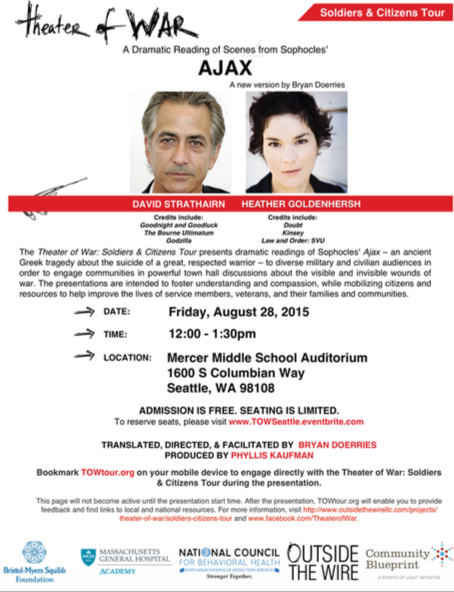
he National Council is involved in: “Theater of War: Soldiers & Citizens Tour.” We are partnering with Outside the Wire, a social impact company that uses theater and a variety of other media to address pressing public health and social issues, on a 2-year grant from the Bristol-Myers Squibb Foundation.

The partnership involves presenting the Theater of War: Soldiers & Citizens Tour to diverse military and civilian audiences to engage communities in powerful town hall discussions about the visible and invisible wounds of war.  Each performance includes dramatic readings of Sophocles’ Ajax — an ancient Greek tragedy about the suicide of a great, respected warrior — by professional actors, a panel discussion, and a moderated open discussion with the audience.  The presentations are intended to foster understanding and compassion, while mobilizing citizens and resources to help improve the lives of service members, veterans, their families, and communities.

The next performances in your area is Friday, August 28 at the Mercer Middle School Auditorium in Seattle from Noon- 1:30 p.m. and the Clover Park Technical College, Building 3 Rotunda in Lakewood from 6 pm to 7:30 pm.

Peace,

Arthur T. Satterfield, Ph.D.

Clinical Director

Seattle Vet Center

TOW SC Lakewood Community Cast Flyer

Theatre

One More Reason to attend the Operation: Welcome One Home, Story Corps will be on hand.

In support of Operation: WelcomeOneHome, the community call to action to end Veteran homelessness in King County, the StoryCorps’ Military Voices Initiative is partnering with the Seattle Stand Down and Seattle University to record stories of Veterans, Neighbors, and Landlords that believe every Veteran in King County deserves a home with dignity and love by December 31, 2015.

On August 9th or 10th, 2015, we invite you to have a privately recorded conversation with a family member, friend, neighbor, or landlord. You will have 40 minutes of uninterrupted time to talk to each other about anything that is meaningful to you. StoryCorps will record your conversation on a personal CD, and with your permission, archive a second copy at the Library of Congress. Fill out the registration online at http://www.theseattlestanddown.org/storycorps.html and please read flyer for more details.

MVI Recruitement Flyer WelcomeOneHome

Q&A: The science behind Agent Orange and its lasting effects

Behind-the-scenes of the IOM panel that helped extend reservist medical benefits

By Brian Donohue  |  HSNewsBeat  |  Updated 9:30 AM, 07.28.2015

Posted in: Issues
'Ranch_Hand'_run - from wikipedia-web

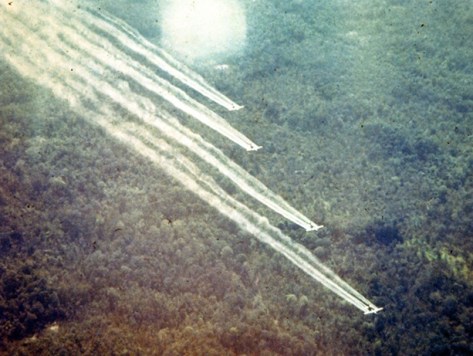
In June, the U.S. Department of Veterans Affairs (VA) reversed a longstanding position and extended medical benefits to about 2,000 Air Force reservists who worked on C-123 aircraft that were returned to the United States after being used to spray Agent Orange defoliant in Vietnam.

The VA was acting on findings of an Institute of Medicine ad hoc panel, whose seven members included John Kissel, a University of Washington professor of environmental and occupational health sciences. In an interview, he gave context to the panel’s job, its process and findings, and his takeaway. This Q&A is excerpted from that conversation.

Q: What’s your background that led to your inclusion on the panel?
A: I do human exposure assessment in community and occupational environments.

Q: What was the panel’s task?
A: We were supposed to decide whether the Air Force reservists who flew and maintained the planes well after Vietnam could have gotten meaningful exposures to Agent Orange residues that would make them potentially eligible for compensation.

John Kissel
John Kissel is a professor of environmental and occupational health sciences.
Years ago Congress decided that, presumptively, all Vietnam veterans were exposed to Agent Orange and its contaminant, dioxin. The standing IOM committee on Agent Orange – another group, not our panel – has reviewed epidemiological records and created a list of health outcomes for which there is an accepted link between Agent Orange exposure and negative consequences. I think 18 or 19 diseases are on the list.

We were looking at a population of people who didn’t go to Vietnam but who may have had equal or higher exposures than some veterans who did. The non-Vietnam veterans were presumptively not covered.

Q: Was the panel going to stand entirely on science, either way, or were you looking for justification to cover the reservists?
A: Just the science. We weren’t unaware of the contention of the non-covered veterans that this was an equity issue, but we weren’t impaneled to deal with equity. We could have said, “It doesn’t seem fair to us, but we found no basis for your claims of exposure.”

Q: Were you lobbied?
A: We had one public hearing where people were able to offer their opinion. There were advocates for the reservists and on the other side there was the VA’s primary consultant as well as consultants paid by Dow and Monsanto, who made Agent Orange, to argue that the reservists’ claims didn’t hold up to scrutiny. We also received written comments on both sides of the issue.

Q: What did the science tell you?
A: We had a problem with lack of information. If you want to assess a person’s or a group’s exposure, you would like to have environmental data from the period of exposure, plus skin data, inhalation data, and urine data from the population. You’d also want to know the length of potential exposure – how many hours a day, how many years. At the individual level, we had little or none of that. What we had was residue numbers obtained from the planes a decade or more after the reservists served. Given that there was still residue in the planes 10 or more years after they had been active, we were confident that there was residue in the planes when the reservists were working.

Q: The dioxin residue was still there?
A: A lot of military aircraft get mothballed in the Arizona desert because things rust slowly. The planes’ doors and windows were sealed up. Dioxin biodegrades very slowly and, if there’s no sunlight, it can’t decompose through photolysis.

Air Force
Dioxin residue was found in aircraft used to spray Agent Orange defoliant in Vietnam.
Q: Your panel’s report didn’t actually recommend coverage for the reservists.
A: It wasn’t ours to decide whether to compensate the reservists. We were asked to answer whether meaningful exposures were plausible. We estimated that the reservists would have been “downhill” in a chemical sense from the surface residues, so exposures would be expected. We also determined that, given the paucity of information, we could not conclude that the reservists’ exposures would have been negligible. We decided that to go to just that far, and left it to the VA to make the final decision.

Q: What do you take from this experience?
A: It’s enjoyable to serve on a panel with bright people to chew on a real problem, and there’s satisfaction in writing a report that somebody read and that apparently made a difference. That doesn’t always happen.